
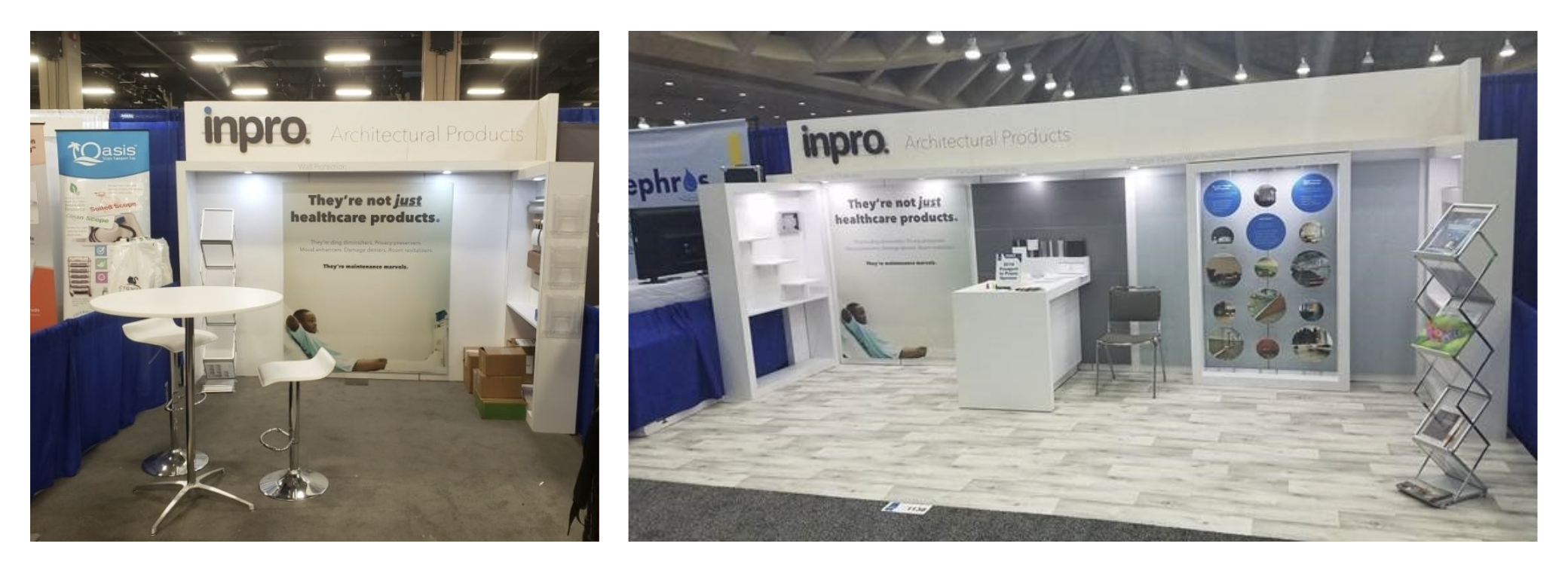
- Can I use the same trade show booth at different shows? Yes, if it’s designed with modular components that can be reconfigured. See the case study below (Strategic Modularity: USCCA) for an example of a booth changing size and footprint.
- How do I design a scalable trade show exhibit? Start with your smallest footprint, separate the structure from the graphics, plan for storage upfront and preview the build before it ships. Need inspiration? Check out the USCCA’s recent transition to modular design below.
- How can I stretch my trade show budget across multiple events? Compare the full cost of one flexible system, including labor, installation and material-handling savings, against building separate exhibits for each show size. See how to compare costs below.
- How do I know if a modular design is right for me? Modular design pays off if you’re hitting multiple show sizes across multiple years. If you’re locked into one show and one footprint, a simpler build makes more sense.
Every marketing manager running a trade show calendar knows the pressure of figuring out how one exhibit is supposed to work at a flagship show’s 30×40 footprint and a regional show’s 10×10 footprint. Here are several essential questions to answer when designing an exhibit for multiple shows:
Can I use the same trade show exhibit at different shows?
The short answer is yes, but only if the exhibit was designed to be adaptable from the start.
A good modular system can be built and reconfigured many times over, meaning the same structural components used to build a 30’x40′ can be reassembled into a 10’x20′ for a smaller show.
What parts of an exhibit actually scale up and down?
The goal of a modular exhibit isn’t to make every piece universal, but to know which pieces move and which ones you plan around.
| What typically scales: | What usually stays fixed: |
|
|
Strategic Modularity: USCCA
After 10 years of partnering with Captivate, USCCA needed an exhibit approach that could keep pace with their ambitious event schedule and membership goals. They attend six to seven shows a year, from their flagship presence at SHOT Show to more targeted events and additional site activations. Rather than designing a new exhibit for every show, USCCA invested in a modular system that combines owned inventory with rental components.
For USCCA, modular design isn’t just about reusing hardware; it’s about aligning their exhibit with how they grow membership.
That meant thinking through several key considerations:
- Footprint flexibility across shows: At its flagship event, SHOT Show, USCCA occupies a large entryway space that is impossible to miss, but at other shows, they may work within 20’x20’ or smaller spaces, often with lower height limits and different traffic densities. A modular system lets them scale from ~18′ high structures down to 8′ high configurations, without starting from scratch every time.
- Traffic flow and circulation: In open, lobby‑style or island‑like configurations, visitors can approach from multiple directions, so the layout must welcome circulation from all sides and still guide people toward key engagement points. In more constrained, inline‑style spaces, the design needs to pull people in from one main aisle, using layout, graphics and focal points to keep the space from feeling like a simple “walk‑by.”
- Sightlines and visibility: At SHOT Show, USCCA leverages tall structures and large headers visible from a distance, helping position them as a category leader and industry voice. At smaller or more height‑restricted shows, they rely more on graphic hierarchy, messaging and lighting to maintain that same sense of authority in a more compact frame.
- Engagement zones and membership journey: Some environments are built around thought leadership, with a more “stage‑like” presence where industry experts and influencers are featured under the USCCA brand. Others are more transactional, with built-in kiosks where visitors can submit information and sign up for membership.
- Consistent brand and mission across verticals: Whether they’re speaking to realtors concerned about personal safety at showings or gun owners at SHOT Show, USCCA’s mission remains the same: education, protection and legal representation for responsible gun owners. Modularity lets them adapt the story and supporting graphics to each audience while keeping a consistent visual and structural language that reinforces trust in the brand.
By investing in a modular exhibit strategy, USCCA can show up bigger and smarter at every event while keeping their membership‑driven mission front and center at every touchpoint.
Ready to Switch to a Modular Design? Start Here:
- Start with your smallest footprint: It is easier to add elements back in for bigger shows than to figure out what to cut from a design.
- Separate the structure from the graphics: The structure should carry across sizes, but messaging should be able to be updated independently of it.
- Plan for storage and logistics upfront: This allows you to know where the extra pieces live and who’s responsible for their condition between shows.
- Get a fabrication preview before anything ships: A preview will help catch issues in the shop before your design reaches the show floor.
Pro Tip: A modular design is only as flexible as the team behind it. When one partner owns every phase, design, fabrication, shipping, installation and storage, nothing gets lost in translation between show sizes. Split those pieces across multiple partners, and the flexibility that looked good on paper doesn’t always survive contact with an actual show floor.
Stretch my trade show budget across multiple events
It is important to know that a single modular system costs more upfront than a basic 10’x10’ package.
However, it typically earns that back through:
- Labor and installation savings, since your team isn’t learning a new structure at every show.
- Shipping and handling savings, since one modular kit moves as a set instead of paying separate freight for multiple builds.
- Avoided replacement costs, since you’re not rebuilding a small exhibit from scratch as your program grows.
- Messaging flexibility, since graphics print separately from the structure, so a new campaign, product launch or rebrand means updating graphics, not building a new exhibit.
Here’s how to run the comparison:
- Price both options against the same show calendar: Get a quote for one modular system sized for your largest show, and separate quotes for exhibits sized for each show you’re comparing.
- Add up the full cost of the separate-exhibit path over your planning window (three years is a reasonable default): build cost per exhibit, plus crating and freight, plus labor and installation, for every show in that window.
- Add up the full cost of the modular path over the same window: one upfront build, plus labor and installation per show, plus reconfiguration and storage costs.
- Divide each total by the number of shows in your window to get a true cost per show for each approach.
- Compare the two. Modular systems typically break even by the second or third show. If your calendar has fewer shows than that in your window, a simpler build may genuinely be cheaper.
- After each show, log what labor, installation and repairs actually cost against what you estimated and feed that into next year’s comparison as your calendar changes.
One exhibit, designed well, can carry you through a flagship show and a regional one without reinventing itself, or your budget, every time. The design choices, the storage plan and the cost comparison all work together. Getting them right upfront is what separates an exhibit that actually flexes from one that just gets patched together each year.
If you’re mapping this out for your own show calendar and want a second set of eyes, reach out. We’re happy to help you think it through, whether you’re starting from scratch or trying to figure out if your current exhibit has more scale left in it than you think.